I’m grant ⍾ and welcome to my blog! Learning to Adapt ⚶ is a blog about learning– the biological kind! (sorry, machines). I want to understand how biological systems organize themselves to facilitate adaptation. We all know that nervous systems are adept at learning, though it’s surprisingly not their primary function. However, the epiphenomenon of learning can be ascribed to numerous other information-bearing systems. For example, eukaryotic genomes are bulky with transcriptional noise, orphan receptors, pseudogenes, and duplications. Prokaryotic genomes are, in contrast, streamlined. Similarly, a population carries cryptic genetic diversity that only exposes itself under times of stress or intense selection. These systems hold memory and are shaped by their environment to influence or bias future behavior.
Just in the case of nervous systems, carrying a diverse repertoire of (learned) behaviors or genetic programs requires selective inhibition and disinhibition; rare phenotypes emerge through nonlinear cooperativity of numerous alleles, new genetic programs are generated through duplication and subfunctionalization given chance derepression, and somehow I still remember where all the HMs are hidden in Pokemon Blue. If the brain is organized so as to adapt, how might a population be organized to do the same? How is a genome organized to hasten the work of evolution? Evolution has often been compared to a learning algorithm. But, can molecules learn? Can a culture learn? When will I learn? And critically, what happens when we forget? Hopefully I can share some of the learnings that have captured my fascination, illuminate the subtle but complex processes that we take for granted, and demonstrate that people aren’t so different from genetic elements after all.. if you squint.
Here are some of the topics I’ll be covering in a convient and digestible numbered list.
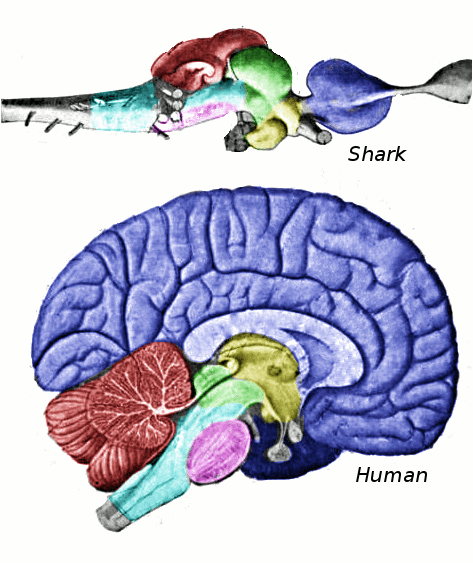
Diagrams of the shark and human brain, with analogous regions colored. Blue: telencephalon; red: cerebellum; yellow: diencephalon; purple: pons; green: mesencephalon; cyan: medulla. Source: Looie496, Public domain, via Wikimedia Commons1. Evolution of the vertebrate nervous system. If you could believe it, nearly all of the structures of the human brain can be identified in a simpler form in the humble lamprey. The seed of mammalian neocortex (the big wrinkly part) was sown as paleocortextwo-layer cortex of the olfactory bulb
of the early vertebrate pallium, which was originally an olfactory demultiplexer. The vertebrates established the fundamental cortico-striato-thalamic loops which facilitate action selection, motor learning, and automatization. The basal ganglia originated to answer the questions: “What’s that smell? How do I feel about it? So, what now?
”. In humans, the very same structuresignificantly elaborated
produces addictive behaviors, automatic reactions, Parkinson’s, and rich episodic memory evoked by scent. For better or worse, the well worn paths of your mind are found in the basal ganglia.
The layout of the neural circuitry of the cerebellar cortex. Source: Henry Vandyke Carter, Public domain, via Wikimedia Commons2. The cerebellum. Once regarded as an ancient, dumb microcontroller, this structure is actually younger than pallium, emerging in cartilaginous fish (sharks). It has expanded about as fast asor faster?
the prefrontal cortex in recent human evolution, and exhibits one of the best characterized neural circuits in the brain. The classical view of this structure explains coordination, vestibular sense, proprioception, and stabilization of motion (essentially a PID controller). However since Schahmann’s work in 90’s, it has been investigated for its role in visuospatial processing, language, and mood. Some theories describe its function as a universally teachable forward model which squares the observed against the expected and offers real time corrections. In humans, it has numerous projections to prefrontal cortex (not just premotor or motor). So, what forward model do those projections compute?
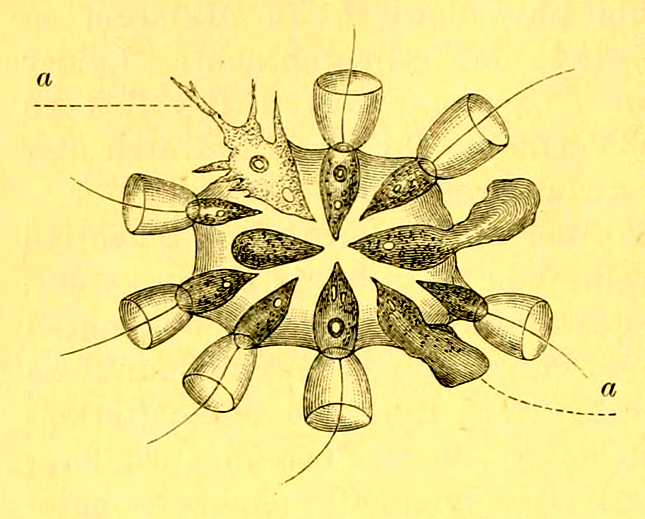
Illustration of small colony of choanoflagellates, the single-celled ancestors to all metazoa. Source: Iliá Méchnikov, Public domain, via Wikimedia Commons3. The social contract of multicellularity. So much to say here, so little space. The animal is a city, cells are its citizens, and getting them to get along wasn’t trivial. To convince a cell to fulfill a role deep inside of tissue, you need to make sure the system can reliably support its metabolic needs, and to convince it to give up reproductive autonomy. Most eukaryotes know how to die, but how do you get them to perform apoptosis on command? That may sound sinister, but it’s a core function of animals that is employed heavily during embryogenesisand adult life. Somehow, the animal system arrived at a solution that helps the cells go peacefully. The echoes of these original game theory dilemmas can still be seen in the pathogenesis of the prototypical disease of the animal: cancer.
Schematic of cadherins engaging in homophilic binding at the adherens junction. Not the same as AF, but structurally homologous. Source: lu.qianhe, CC BY-SA 4.0, via Wikimedia Commons4. Sponges, aggregation factor, and allorecognition. In order to form colonies, choanoflagellates had to learn to hold hands. Rather, they learned to shake hands as a symbol of trust and common origin. Allorecognition, identifying self from non-self, is an essential function of multicellular life that helps dissuade parasitism and other infectious disease. To stay ahead of quickly adapting viruses, allorecognition systems have to adapt fast. In a way, allorecognition is like a cryptographic key that enforces trust, enabling all the amenities of an animal society. These simple lectins potentially form the basis for a number of adhesion molecules that ultimately make vertebrate life feasible. The fact that sugar flows in our blood is not a trivial accomplishment!
Gene regulatory network diagram for pancreatic cell differentiation. All GRNs take output from the outside world via ligand-receptor interactions. Source: Zhou JX, Brusch L, Huang S, CC BY 4.0, via Wikimedia Commons5. The evolution of signal transduction pathways. In order to transduce a signal, you need a ligand and a receptor. What good is a ligand without a receptor, or a receptor without its ligand? Eukaryotic cells are surprisingly effective associative engines and employ a number of strategies to entrain themselves to the signals of their world, quickly. The question of how receptors evolve to ligands (and the converse) reveals why endogenous opioids work the way they do, why the hypothalamus and pituitary form such a funny shape, and why you have receptors in your brain that respond to bacterial byproducts.
I also like to work on little widgets and doodads that help me explore the system that I’m investigating. These are the things I’m planning to develop and share:
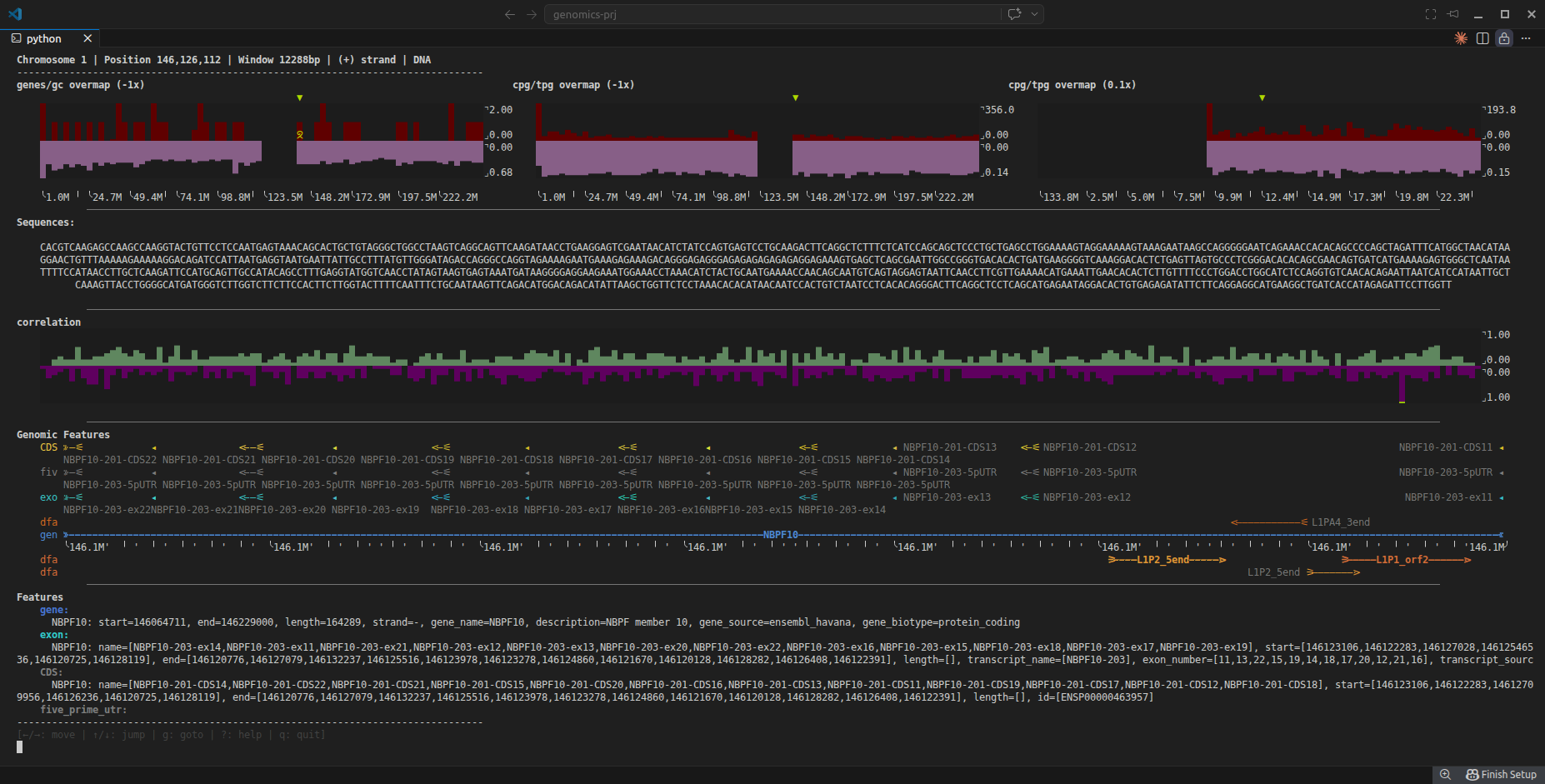
1. Genome browser: I’m working on a fun genome browser that you can use to zoom around our DNA sequences and see what little critters lurk within. Our DNA tells the stories of our ancestors!my genome browser
2. Neural circuits: Neurons and nervous systems use myriad organizational principles to process information and generate behavior.
3. Morphogenesis and gene regulatory networks: Animal cells produce animal bodies through a long and intricate series of dance steps, a conga line that culminates in a thinking creature. They execute this in part by decompressing their nuclear instructions, encoding in their morphology a memory of all the signals they heard and sensations they felt on the way. Cool!
4. LLM playground: a major part of what makes human intelligence unique is our embodied experience of the world and the sensory-executive-motor feedback loop that trains us to move within it. LLMs, in contrast, experience the world via a tiny keyhole through which flows your words, and sometimes “image tokens”, if they’re lucky. What behaviors emerge when symbolic pattern matching engines are provided with sociocultural scaffolding and data driven reality testing?
this site will never store cookies or other information about you (except dark mode). that would be weird!
 ”. In humans, the very same structuresignificantly elaborated
produces addictive behaviors, automatic reactions, Parkinson’s, and rich episodic memory evoked by scent. For better or worse, the well worn paths of your mind are found in the basal ganglia.
”. In humans, the very same structuresignificantly elaborated
produces addictive behaviors, automatic reactions, Parkinson’s, and rich episodic memory evoked by scent. For better or worse, the well worn paths of your mind are found in the basal ganglia.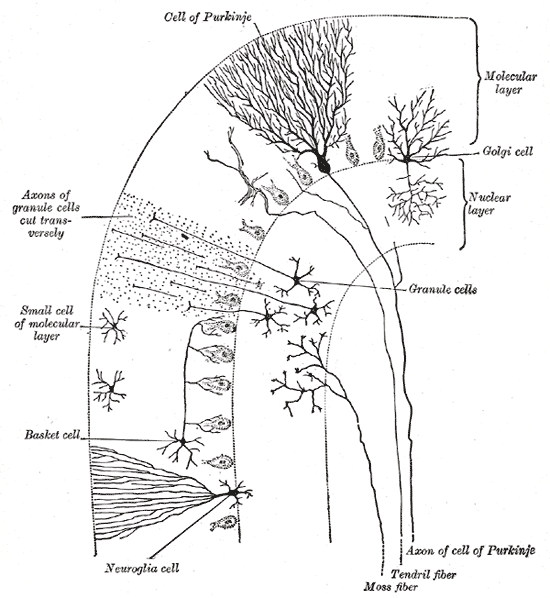
, via Wikimedia Commons](/images/posts/welcome/adh_junct_for_AF.jpg)
, via Wikimedia Commons](/images/posts/welcome/grn_sig.png)